
The electricity utility industry employs a simple strategy for maintaining reliability: always have more supply available than may be required. Yet it can be difficult to forecast future electricity demand, and building new generating capacity can take years. The industry regularly monitors the supply situation using a measure called reserve margin. Regional estimates of reserve margins are compared to pre-determined target levels to assess supply adequacy.
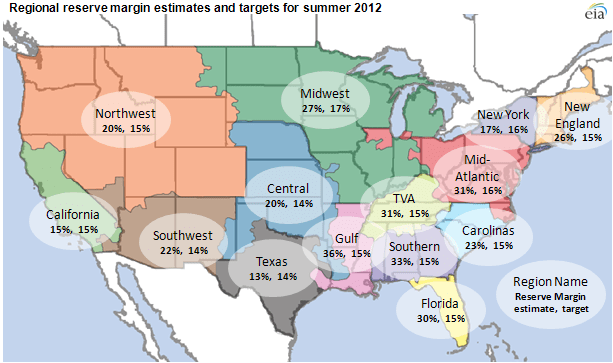
Reserve margin is (capacity minus demand)/demand, where “capacity” is the expected maximum available supply and “demand” is expected peak demand. It is calculated for electric systems or regions made up of a number of electric systems. For instance, a reserve margin of 15% means that an electric system has excess capacity in the amount of 15% of expected peak demand. The map shows 14 regional reserve margin estimates and the target reserve margins for summer 2012, which are derived from the North American Electric Reliability Corporation’s (NERC) recently-released 2012 Summer Short-Term Reliability Assessment. NERC Regional Entities set their region’s target reserve margin.
The reserve margin estimates exceed the target in every region, except in ERCOT (most of Texas). Southeastern and Mid-Atlantic regions currently have reserve margins well above their region’s target level, indicating significant excess capacity.
Categories: Electricity, Energy
 Prometheus Institute