
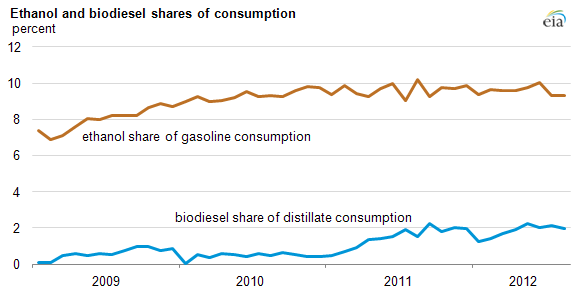
From 2009 to the middle of 2012, the U.S. biofuels industry, encompassing all liquid fuels derived from renewable sources, ramped up output to meet mandates for increased biofuels use under the Renewable Fuel Standard (RFS2) implemented by the Energy Independence and Security Act of 2007, according to EIA’s recently released report Biofuels Issues and Trends.
Ethanol grew from 8% of U.S. gasoline consumption by volume in 2009 to nearly 10% in 2011 and in the first eight months of 2012. Volume shares are an important metric because of limits on the share of biofuels that can be used in motor fuels approved for use in all vehicles. Biodiesel consumption grew from 326 million gallons in 2009 to 878 million gallons in 2011, after having declined in 2010. Biodiesel’s share of all distillate fuel reached 2.2% in September 2011 and, after declining over the past winter, was at or above 2% in the spring and summer of this year.
Ethanol production rose steadily over the past decade, increasing from 2.1 billion gallons in 2002 to 13.3 billion gallons in 2010. Growth in ethanol production slowed after 2010 as ethanol’s share in the gasoline pool approached 10% by volume. Ethanol production in 2011 was 13.9 billion gallons, and monthly production through the first half of 2012 remained close to that level. However, production has slowed somewhat since July, in part because of the drought’s impact on the current corn crop and the price of corn.
Biodiesel production has followed a different path. In 2010, the production of biodiesel fell 34%, at least partly due to the expiration of the biodiesel tax credit at the end of 2009. The reinstatement of the credit in late 2010, retroactive to the beginning of the year, coupled with increased demand under the RFS2, reversed the decline in 2011. The federal excise tax credits for non-cellulosic ethanol and biodiesel and the ethanol import tariff expired at the end of 2011. The production tax credit for cellulosic biofuel is scheduled to expire at the end of 2012.
Categories: Energy, Policy, Transportation
 Prometheus Institute