
Firmed solar and wind deliver the cheapest pathway for new electricity supply across all scenarios in Australia, the Commonwealth Scientific and Industrial Research Organisation (CSIRO) says in its latest cost report.
CSIRO’s draft GenCost report for 2025-26 shows that solar and onshore wind power backed by storage and either gas or hydrogen is the least-cost new-build electricity generation technology mix.
The draft GenCost report, compiled with the Australian Energy Market Operator (AEMO), provides verifiable cost data of new-build electricity generation in terms of capital costs and comparative costs of delivered electricity from individual technologies.
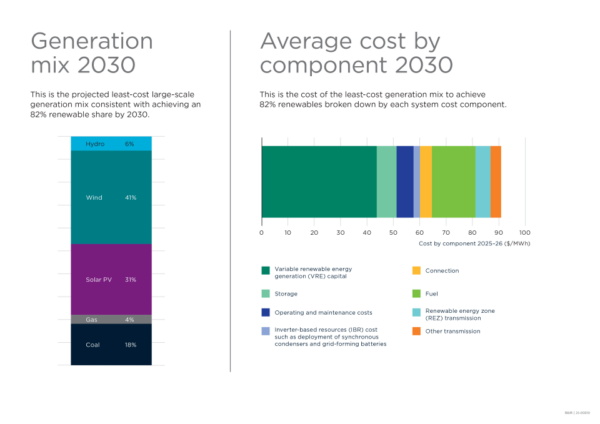
This edition also introduces new modelling that examines the electricity generation mix and the average cost of electricity for achieving Australia’s 82% renewable energy target by 2030 and reaching net zero emissions by 2050 under different electricity emission intensity scenarios.
CSIRO said in all scenarios examined, the combination of solar, onshore wind, storage and either gas or hydrogen was the least-cost technology mix.
The average cost of electricity in the National Energy Market (NEM) consistent with meeting the 82% renewables target is projected to be AUD 91/MWh ($60.28) including transmission, or AUD 81/MWh for generation alone. This compares with the current average cost of AUD 129/MWh, the report said.
To deliver net zero by 2050, generation costs were projected to be AUD 135/MWh to AUD 148/MWh including transmission.
“The combination of solar PV, onshore wind, storage and either natural gas or hydrogen was the least cost technology mix in all cases examined with the addition of carbon capture and storage, offshore wind and nuclear leading to higher average electricity costs,” CSIRO said, noting that the outcomes are based on average costs.
Federal Industry Minister Tim Ayres said the report “reinforces the importance of continued investment in wind, solar, and storage to deliver affordable, reliable energy for Australian businesses, homes and industry.”
“Renewables are not just the cleanest energy option, they’re the cheapest,” he said, adding that the “economics are clear. We need to crack on with the job at hand, building out more renewable energy more quickly to replace retiring coal-fired power generation.”
Large-scale battery costs performed best in terms of delivering capital cost reductions, dropping by between 11% and 16%, depending on the duration. This follows a 20% fall in 2024-25.
Large-scale solar PV has its first cost rise in three years, increasing by 8% for 2025-26, compared to an 8% decrease in 2024-25. CSIRO said this represents a reversal of the last two years of gains but “likely reflects cost volatility rather than a new trend.”
Onshore wind costs dropped 5% over the 2025-26 period and show “tentative signs of stabilizing” following a 35% increase in 2022-23.
“The change in current costs over the past four years indicates an easing of inflationary pressures for solar PV, wind and batteries while coal and gas technology costs have recently increased significantly,” the organisation said.
CSIRO’s projections show coal costs increase by 13% over the 2025-26 period while gas-fired generation climbs by up to 32%.
Clean Energy Council Chief Executive Officer Jackie Trad said the figures demonstrate that Australia can replace retiring coal capacity while maintaining affordability and reliability for households and businesses.
“The GenCost report’s assessment of electricity costs at a whole-of-system level, rather than comparing individual technologies in isolation, finds renewables-led systems consistently outperform alternatives on cost,” she said.
“The report confirms that building a new coal-fired power station would deliver electricity for at least double the price of solar and wind. This is once again confirmation that the lowest-cost electricity system for Australia is built on renewable energy backed by storage and firming.”
via pv magazine International https://ift.tt/uYClIAF
Categories: Energy
 Prometheus Institute