
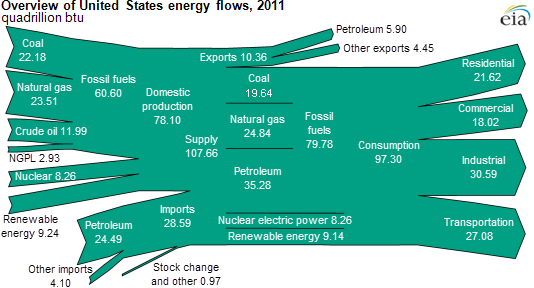
The United States flow of energy from supply to demand is complex. Petroleum, natural gas, and coal together account for about 82% of our energy use, with renewable and nuclear energy providing the rest of our energy use. The United States is both an importer and exporter of energy.
From production on the left to consumption on the right, the four main components of the U.S. energy flow are:
Domestic production (78.10 quadrillion Btu). Of the roughly 78 quadrillion Btu (quads) of domestic production in 2011, approximately 61 quads came from nonrenewable fossil fuels: coal, natural gas, crude oil, and natural gas plant liquids. Another 8 quads came from nuclear electric power, while renewable sources including hydroelectric power, biomass, geothermal, solar-photovoltaic, and wind provided an additional 9 quads.
Imports (28.59 quadrillion Btu). Over 85% of U.S. energy imports are crude oil and petroleum products. The remaining imports include natural gas, coal, coal coke, biofuels, and electricity.
Exports (10.36 quadrillion Btu). About 57% of U.S. energy exports are crude oil and petroleum products. Similar to imports, other exported products include natural gas, coal, coal coke, biofuels, and electricity.
Consumption (97.30 quadrillion Btu). In 2011, the industrial sector consumed 31 quads, the most energy of the four sectors. The transportation sector consumed about 27 quads, while the buildings sectors—residential and commercial—consumed about 22 quads and 18 quads, respectively. These consumption totals include electrical systems energy losses associated with generation of the electricity that is used in each sector.
Categories: Energy
 Prometheus Institute